Gamification Beyond Leaderboards: When Learning Feels Worth Playing
Written By
EngageSlide Team
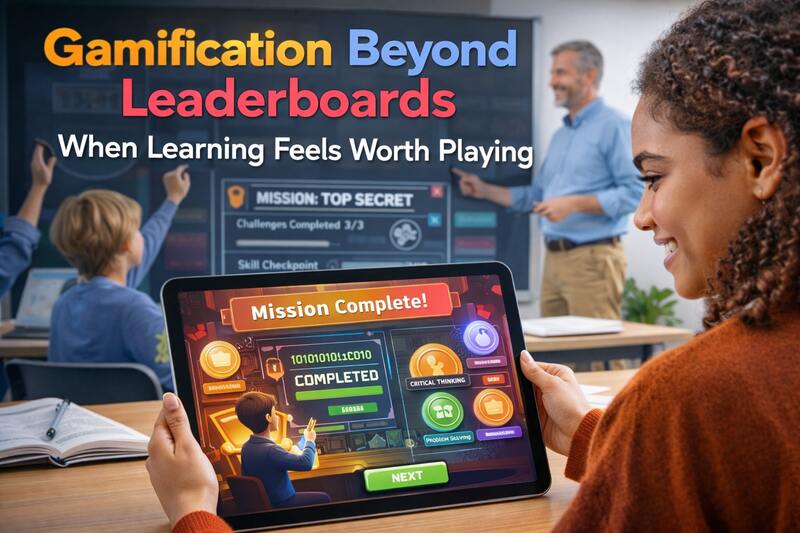
Most classrooms have tried gamification at least once.
A leaderboard on the screen.
A few points for correct answers.
Maybe a badge at the end of the lesson.
It looks exciting at first — but then something happens. The same students stay on top. Others stop caring. Engagement fades. What was supposed to feel like a game slowly turns into another grading system.
That’s when many educators ask the wrong question:
“Why doesn’t gamification work?”
The better question is:
What kind of gamification are we using?
Gamification Was Never About Points
Games don’t hook people because of points. They hook people because they create meaningful progress.
Think about any game you’ve ever enjoyed. You weren’t playing for the score alone. You were playing because:
You knew what you were working toward
Challenges felt achievable, not random
Feedback was immediate
Progress was visible
Failure didn’t end the journey — it guided it
That’s the kind of experience gamification is meant to bring into learning.
When we reduce gamification to leaderboards, we lose the very thing that makes games powerful: the feeling of growth.
Why Leaderboards Often Backfire
Leaderboards reward comparison, not learning.
For a small group of competitive students, rankings can be motivating. For everyone else, they quietly signal something else: you’re behind, and it’s public.
Once a learner believes they can’t catch up, they disengage — not because they don’t care, but because the system tells them their effort won’t matter.
True gamification shifts the focus away from “Who’s winning?” to a far more powerful question:
“How far have I come?”
What Gamification Looks Like When It Actually Works
Effective gamification feels less like a scoreboard and more like a journey.
Learning becomes a sequence of meaningful steps rather than isolated tasks. Students understand where they are, what’s next, and why it matters.
Instead of chasing points, they pursue:
Mastery of skills
Completion of challenges
Unlocking new opportunities
Solving problems that feel real
This kind of design doesn’t demand competition — it invites participation.
Narrative Turns Content Into Experience
Stories matter more than we think.
When learning is wrapped inside a narrative — a mission, a challenge, a problem to solve — students don’t just complete tasks. They inhabit them.
A quiz stops being “Question 1 to 10” and becomes:
A checkpoint
A decision point
A moment that moves the story forward
Narrative doesn’t need to be complex or fictional. Even a simple framing — “Today, you’re solving a real-world problem” — can transform attention and motivation.
Mastery Beats Speed Every Time
Games reward improvement, not just speed.
In learning, mastery-based gamification means students are encouraged to:
Retry without penalty
Learn from feedback
Progress when ready, not when rushed
This removes the fear of failure and replaces it with curiosity.
When mistakes become part of the system — not something to avoid — learners stay engaged longer and build confidence faster.
Feedback Is the Real Reward
One of the most underrated elements of gamification is feedback timing.
In traditional classrooms, feedback often arrives days or weeks later. In games, feedback is instant — and that immediacy keeps players invested.
Learning benefits from the same principle.
When students see the impact of their choices right away, they adjust, reflect, and try again. Engagement becomes a loop, not a one-time event.
This is why interactive moments inside lessons matter so much. Even simple actions — polls, quick challenges, live questions — keep learners mentally present.
For educators who want to add these interactions seamlessly into presentations, tools like EngageSlide allow live quizzes and interactive moments to exist inside the lesson flow, rather than as separate activities.
Collaboration Is a Game Mechanic Too
Not all games are competitive. Many of the most memorable ones are cooperative.
Gamification can encourage:
Team problem-solving
Shared goals
Collective progress
When learners work together toward a common objective, engagement becomes social — and social motivation is one of the strongest drivers of persistence.
This approach also creates safer learning environments, where students support each other instead of comparing scores.
Where Gamification Often Goes Wrong
Gamification fails when it becomes decoration instead of design.
Common mistakes include:
Adding points without purpose
Rewarding speed over understanding
Ignoring students who fall behind
Making the system more complex than the learning itself
Gamification should never distract from learning. It should clarify it.
If students focus more on earning rewards than understanding concepts, the system needs rethinking.
The Future of Gamification in Learning
The future isn’t louder leaderboards or flashier badges.
It’s learning experiences that feel:
Intentional
Responsive
Human
Gamification will continue evolving toward:
Personalized learning paths
Real-time interaction
Mastery-focused progression
Meaningful feedback loops
When designed with care, gamification doesn’t make learning childish. It makes it alive.
One Last Thought
Gamification beyond leaderboards isn’t about making learning easier.
It’s about making effort feel worthwhile.
When students feel progress, agency, and purpose, they don’t need to be forced to engage — they choose to.
And that’s when learning stops feeling like an obligation
and starts feeling like something worth playing through.
Implement This Strategy Effectively.
Transform these academic insights into real-time audience engagement using the right platform.
Try EngageSlide Free