Active Recall: The Most Powerful Learning Strategy for the Modern Classroom
Written By
EngageSlide Team
Introduction: Why Traditional Studying No Longer Works
In today’s fast-paced educational environment, students are exposed to more information than ever before. Slides, videos, textbooks, and digital resources are everywhere — yet many learners still struggle to remember what they study. Traditional methods like rereading notes, highlighting textbooks, or passively watching lectures often create the illusion of learning without delivering real results.
This is where Active Recall comes in.
Active Recall is one of the most research-backed learning strategies in cognitive science. Instead of passively reviewing information, learners actively retrieve knowledge from memory. This simple shift — from exposure to retrieval — dramatically improves long-term retention, understanding, and academic performance.
In the modern classroom, where engagement and learning outcomes matter more than memorization, Active Recall is becoming an essential tool for both teachers and students.
What Is Active Recall?
Active Recall is a learning technique that requires students to actively retrieve information from memory rather than rereading or reviewing content. The focus is on asking questions and forcing the brain to search for answers.
Examples of Active Recall include:
Answering questions without looking at notes
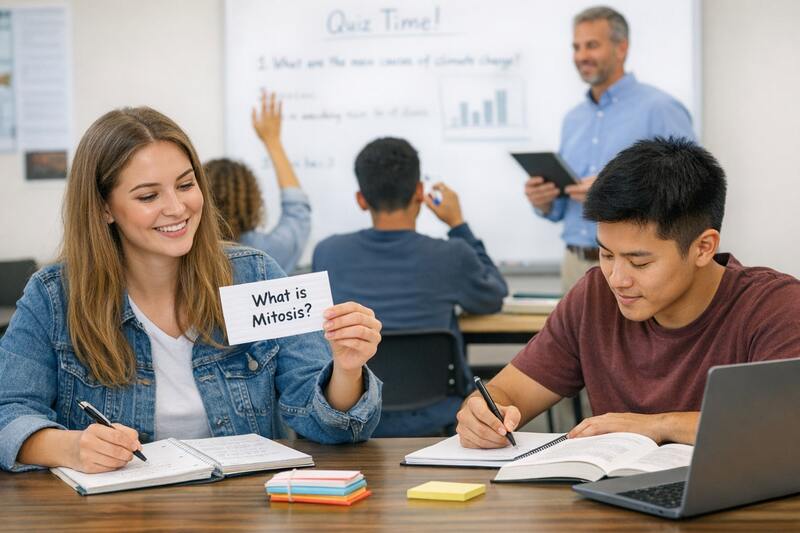
Using flashcards
Taking short quizzes
Explaining concepts out loud from memory
Writing down everything you remember about a topic before checking your materials
Unlike passive learning, Active Recall strengthens neural pathways every time information is retrieved, making it easier to remember in the future.
The Science Behind Active Recall
Active Recall works because of a phenomenon known as the testing effect. Research in cognitive psychology consistently shows that retrieving information improves memory more than simply re-exposing yourself to the same content.
When the brain struggles to recall information:
Neural connections become stronger
Memory traces become more durable
Future recall becomes faster and more accurate
Even when students make mistakes, the act of trying to remember is beneficial. In fact, effortful recall followed by feedback is one of the most effective ways to learn.
This makes Active Recall especially powerful for exams, presentations, and real-world problem solving — situations where information must be recalled without external aids.
Why Active Recall Is Perfect for the Modern Classroom
Modern classrooms emphasize:
Critical thinking
Student participation
Engagement over memorization
Continuous assessment instead of high-pressure exams
Active Recall aligns perfectly with these goals.
Instead of students passively listening, they are constantly interacting with the material. Instead of teachers guessing what students understand, retrieval activities reveal knowledge gaps immediately.
Active Recall also works well with digital tools, interactive presentations, and formative assessments — making it ideal for both in-person and online learning environments.
Key Benefits of Active Recall
1. Long-Term Memory Retention
Students remember information for weeks or months instead of days. This reduces last-minute cramming and improves cumulative learning.
2. Deeper Understanding
Retrieval forces learners to organize ideas, connect concepts, and understand relationships rather than memorizing isolated facts.
3. Better Exam Performance
Active Recall closely mirrors exam conditions, where students must recall information without notes.
4. Increased Student Engagement
Frequent questions, quizzes, and discussions keep students mentally active and focused.
5. Accurate Self-Assessment
Students quickly identify what they know and what they don’t — eliminating false confidence.
Active Recall vs Passive Study Methods
| Passive Learning | Active Recall |
|---|---|
| Rereading notes | Answering questions |
| Highlighting text | Self-testing |
| Watching lectures | Explaining concepts |
| Familiarity-based | Memory-based |
| Low retention | High retention |
While passive methods may feel easier, they produce weaker learning outcomes. Active Recall may feel harder — but that difficulty is exactly what makes it effective.
Practical Active Recall Techniques for Students
1. Flashcards
Flashcards are one of the most popular Active Recall tools. Write a question on one side and the answer on the other. Try to answer before flipping the card.
2. Brain Dump
At the end of a study session, write down everything you remember about the topic from memory. Then compare it with your notes.
3. Practice Questions
Create your own questions or use quizzes to test your understanding regularly.
4. Teaching the Material
Explaining a concept out loud — as if teaching someone else — reveals gaps in understanding and reinforces memory.
5. Retrieval Journals
Instead of traditional notes, write answers to questions without looking at resources, then correct yourself afterward.
How Teachers Can Use Active Recall in the Classroom
Low-Stakes Quizzes
Short, frequent quizzes that don’t heavily impact grades encourage learning without anxiety.
Checkpoint Questions
Pause during lessons and ask students to recall key points before moving on.
Think-Pair-Share
Students recall information individually, discuss with a partner, then share with the class.
Exit Tickets
Ask students to write answers to a few recall questions before leaving class.
Interactive Presentations
Live polls, quizzes, and word-cloud questions turn lectures into active learning experiences.
Combining Active Recall with Spaced Repetition
Active Recall becomes even more effective when combined with Spaced Repetition — reviewing information at increasing intervals over time.
Instead of studying a topic once:
Review after 1 day
Again after 3 days
Again after 1 week
Again after 1 month
Each recall session strengthens memory just as it begins to fade, creating long-lasting retention.
Common Mistakes When Using Active Recall
❌ Checking answers too quickly
Struggling to recall is part of the learning process.
❌ Using it only before exams
Active Recall works best when used consistently throughout the course.
❌ Avoiding difficult topics
The hardest material often benefits the most from retrieval practice.
❌ No feedback
Always review answers after recall to correct misunderstandings.
Active Recall in Digital and Online Learning
In online and hybrid classrooms, Active Recall is more important than ever. Digital tools allow educators to:
Embed quizzes into presentations
Collect real-time responses
Visualize understanding instantly
Adapt lessons based on feedback
These approaches transform remote learning from passive screen-watching into active participation.
Conclusion: Learning That Actually Lasts
Active Recall is not a trend — it is a proven learning strategy grounded in decades of research. In the modern classroom, where engagement, understanding, and long-term retention matter, it outperforms traditional study methods by a wide margin.
By shifting from passive review to active retrieval, students learn more efficiently, teachers gain clearer insights, and classrooms become more dynamic and effective.
Whether you are a student aiming for better results or an educator designing impactful lessons, Active Recall is one of the most powerful tools you can adopt today.
Implement This Strategy Effectively.
Transform these academic insights into real-time audience engagement using the right platform.
Try EngageSlide Free